

Saturday kicks off, the telly in the living room is trying to carry a live match, someone else wants a film in the bedroom, and the Wi‑Fi is already groaning. That is the moment most UK households start looking at IPTV for UK and asking a blunt question, will this work on my broadband, or is it just another subscription that falls apart at peak time?
The honest answer is simple. IPTV can be a very good fit for British homes, but only if you treat it as a broadband product first and a channel product second. If your line, Wi‑Fi and device setup are sound, IPTV can replace a lot of what people used to pay Sky for. If they're not, you'll spend more time buffering than watching.
Table of Contents
- What IPTV Means for UK Households
- IPTV Compared to Freeview, Sky and NOW
- UK Legal and Consumer Considerations
- Choosing a UK-Compatible IPTV Provider
- Setup Highlights by Device
- Broadband, Wi-Fi and the 4K Headroom Rule
- VPNs, Throttling and Basic Privacy
- Troubleshooting and FAQs for UK Viewers
What IPTV Means for UK Households
The plain-English version
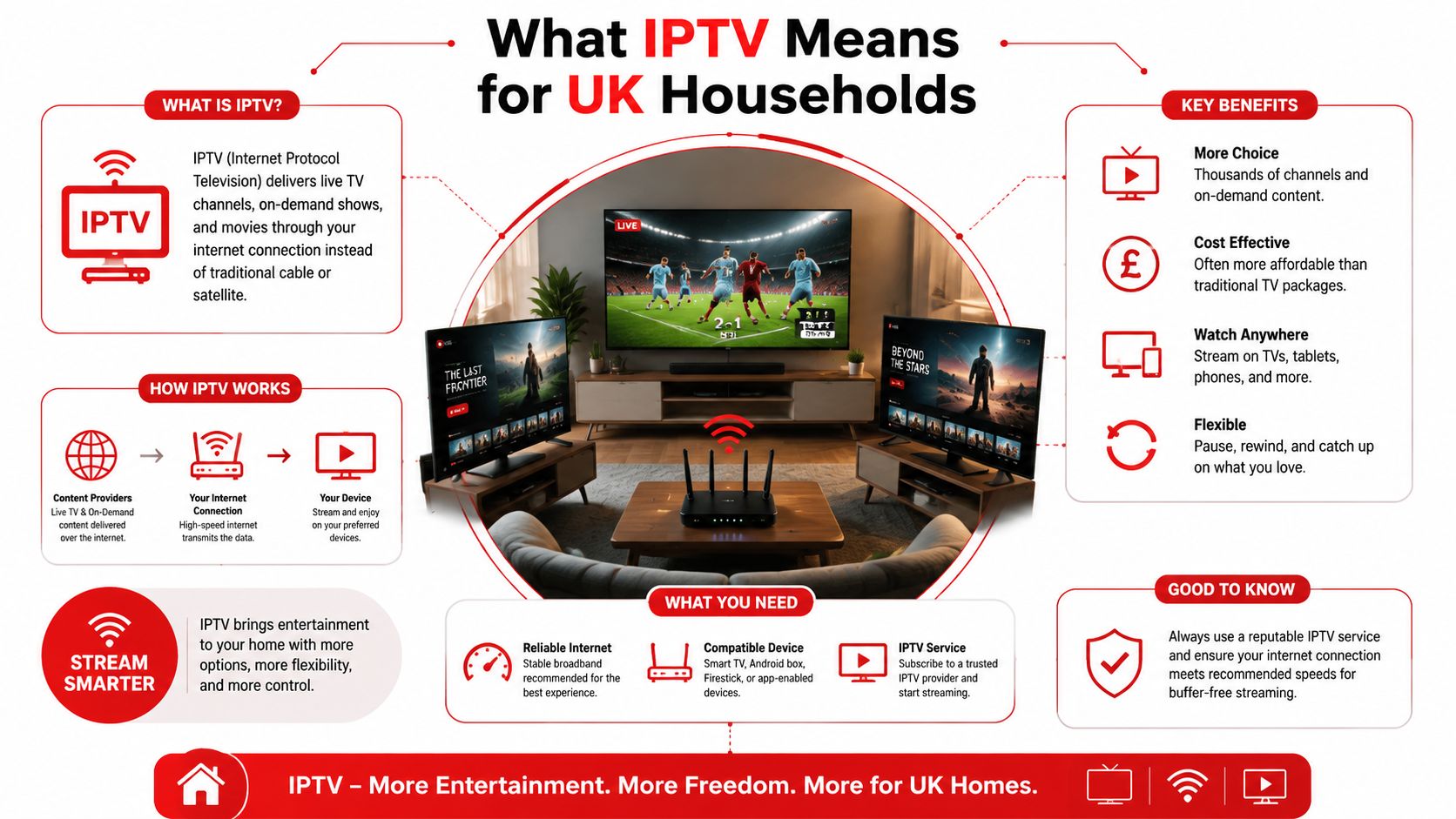
IPTV means television delivered over the internet rather than through a satellite dish, aerial, or cable feed. In practice, that usually means a provider gives you an app, a login, and access to live channels plus on-demand content in one place. It feels closer to a modern streaming service than old-school broadcast TV, but it's built around live TV as well as catch-up and video on demand.
That distinction matters. Netflix gives you on-demand shows and films. BBC iPlayer and similar broadcaster apps give you catch-up or live streams for a single network or family of networks. IPTV sits in the middle, because it usually aggregates many live channels, an EPG, and a large library through one subscription.
Why it works now in the UK
The UK is finally in a place where IPTV makes sense at scale. By the end of 2023, 86% of primary TV sets in UK households were internet-capable (UK government, Future of TV Distribution). That doesn't guarantee a perfect experience, but it means most homes already own the display side of the setup.
The same government analysis estimates that 28.0 million UK homes, about 95%, will be capable of using IP-delivered TV services by 2040 (UK government, Future of TV Distribution). It also says 3.3 million UK households, 12%, still relied solely on DTT in May 2024 (UK government, Future of TV Distribution). That split tells you exactly where IPTV fits today, in broadband-connected homes with enough network stability to carry live video properly.
Practical rule: if your household already uses smart TVs, Firesticks, or TV boxes comfortably, IPTV is a realistic option. If your Wi‑Fi is weak in the room where the main TV sits, fix that first.
What you need before you buy
You do not need a full rewiring job, but you do need three basics. First, a decent broadband line. Second, a compatible device, usually a Firestick, smart TV app, Android box, Apple TV, or MAG box. Third, enough home network headroom that one stream isn't fighting with everything else in the house.
If your goal is to replace satellite outright, IPTV can do it. If your goal is to keep a backup for bad weather or broadband outages, IPTV works better alongside Freeview or Freesat than as a sole service. The right answer depends on how reliable your connection is, not on marketing promises.
IPTV Compared to Freeview, Sky and NOW
Where IPTV wins and where it doesn't
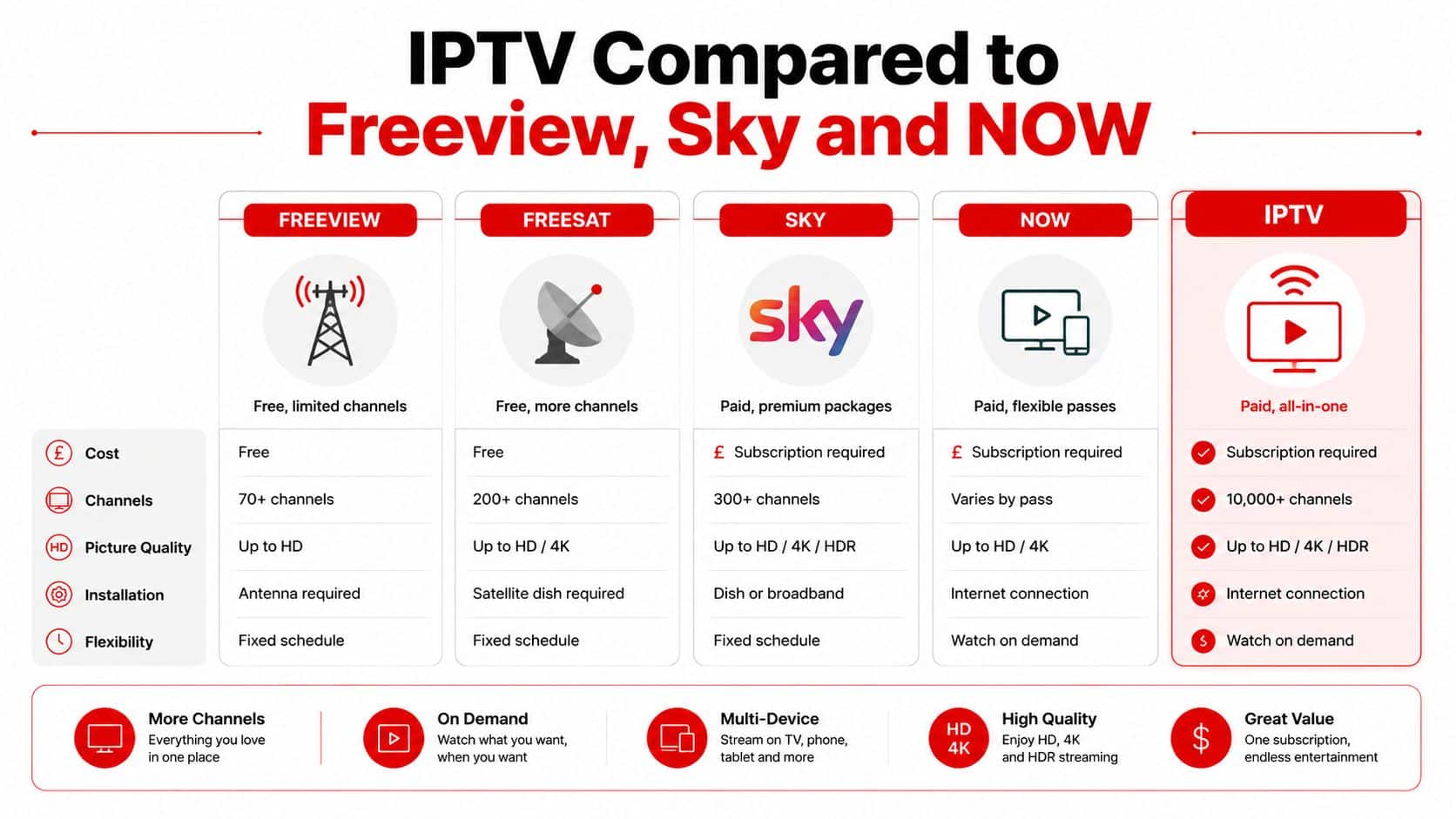
A typical UK viewing setup now starts with the broadband line, not the aerial or dish. If your connection holds up at peak time, IPTV gives you the most flexibility, and if it doesn't, the weaknesses show fast.
IPTV wins on flexibility. You can move it between rooms, use it on multiple device types, and usually get live TV plus on-demand content through one interface. For households that want to avoid long contracts and keep viewing on streaming devices, that is a genuine advantage.
Freeview and Freesat still matter because they keep working when broadband doesn't. That trade-off never goes away. If the line drops, or your Wi‑Fi falls apart during a storm, IPTV stops. A dish or aerial service keeps going.
Sky sits in a different bucket. It remains the familiar choice for people who want a packaged premium TV service with a mainstream support structure and a clear route to premium sports and films. NOW is the lighter, contract-free option for viewers who want Sky-owned streaming passes without the full satellite commitment.
The decision most UK homes make
The right setup for many households is a split, because that is what survives real life. Put IPTV in the bedroom, kitchen, or on portable devices, then keep Freeview or Freesat on the main living-room TV as the fallback. That approach is plain, but it works.
If you want premium sport on the main television and you do not trust your broadband at peak time, satellite still has the edge for resilience. If you want a lower-friction setup that works across more devices and your broadband is solid, IPTV is usually the better fit. If all you need is basic UK channels, Freeview still does the job and costs nothing at the point of use.
The mistake I see most often is people trying to make IPTV do everything on a flaky line. IPTV is brilliant on stable broadband. It is frustrating on marginal Wi‑Fi.
A sensible UK household mix
A practical layout looks like this:
- Living-room TV: Freeview or Freesat as a fallback.
- Second TV or Firestick: IPTV for live channels and VOD.
- Mobile viewing: A streaming app for travel or spare-room use.
- Premium sport fan household: Keep a fallback path if you care about reliability during match time.
That is not a downgrade. It is the cleanest way to stop one broadband connection from carrying every viewing decision in the house.
UK Legal and Consumer Considerations
IPTV in the UK is not one thing, and buyers need to stop pretending it is. Licensed services are straightforward. Unlicensed resellers are where the risk starts, because the provider may be streaming content they don't have the rights to redistribute. The Intellectual Property Office publishes copyright guidance, and FACT, the police-backed anti-piracy coalition, has been involved in UK enforcement against illegal IPTV operations.
The consumer problem is not abstract. If a provider gets taken down, loses rights, or disappears, your channels can vanish overnight. If you prepaid for months, getting money back can be awkward or impossible. That's why a one-time payment model deserves scrutiny, not blind trust.
What to check before you pay
Use this triage before handing over money:
- Licence clarity. A legitimate service should be clear about what it sells and where it gets content.
- Payment method. Card payments give you more recourse than random bank transfers.
- Refund terms. Short, explicit refund windows are better than vague promises.
- Trial access. A real trial beats a screenshot-heavy sales page.
- Contactability. If support only exists through a disappearing chat handle, that's a bad sign.
A service can sell fixed-duration access without auto-renewal and still be legitimate. The problem is not fixed-term pricing itself. The problem is paying up front for a service you can't verify, with no obvious route to dispute a bad outcome.
What licensed looks like in practice
Licensed products are usually easier to identify because they behave like proper consumer services. They publish clear terms, use mainstream payment rails, and don't ask you to treat the purchase like a gamble. By contrast, a flat-fee reseller pushing thousands of channels and no meaningful service terms is asking you to absorb the risk.
Use the rule that matters most in this space. If the seller can't explain what happens when the service fails, don't buy for long. Treat any prepayment as spend-at-risk, not guaranteed access.
Choosing a UK-Compatible IPTV Provider
A decent IPTV provider is judged on a Tuesday night at 8.15 p.m., not on a sales page full of claims. That is the point UK households should care about, because peak-time broadband use exposes weak providers fast. If the service struggles when the rest of the house is streaming, gaming, and scrolling, it will annoy you regularly.
I would use seven checks before paying for anything. Channel mix, VOD freshness, 4K/UHD support, peak-time stability, payment terms, trial or refund policy, and human support quality tell you far more than any headline channel number. If a provider hides those details behind vague language, move on.
What a credible answer looks like
- Channel mix: Make sure the lineup suits your home, with enough UK and international channels to be useful, not just a big number on a banner.
- VOD library: Fresh content matters more than a bloated library. A huge stale catalogue still feels stale.
- 4K support: Check that it works on the devices you already own, not only in the advert.
- Peak-time reliability: A provider that can explain how it handles football nights and evening congestion is giving you a real operational answer.
- Activation terms: Fast delivery is normal. A service that needs long manual delays is a poor bet.
- Trial and refund policy: A short trial is useful. Clear refund terms are better than sales copy.
- Support: If you cannot reach a human when something breaks, the service is too fragile for a household setup.
A quick plan-length comparison
| Plan length | Typical use case | Money-back window |
|---|---|---|
| 1 month | Testing the service on your line and device | Short window, if offered |
| 3 months | Medium confidence after a trial period | Moderate window, if offered |
| 12 months | Only after the service has already proven stable for you | Longer window may be offered, but only if clearly stated |
Use that table as your filter. Start short, then commit longer only after the service has proved itself on your broadband.
One provider that publishes a fixed-term model, a free 24-hour trial, device support, and stated features such as 27,000+ live channels, 100,000+ VOD titles, Anti-Freeze 10.0, 4-day catch-up, and money-back guarantees that vary by plan is UK Best IPTV. I am not saying buy it on trust. I am saying compare it against the checklist above and judge it like any other option.
Setup Highlights by Device
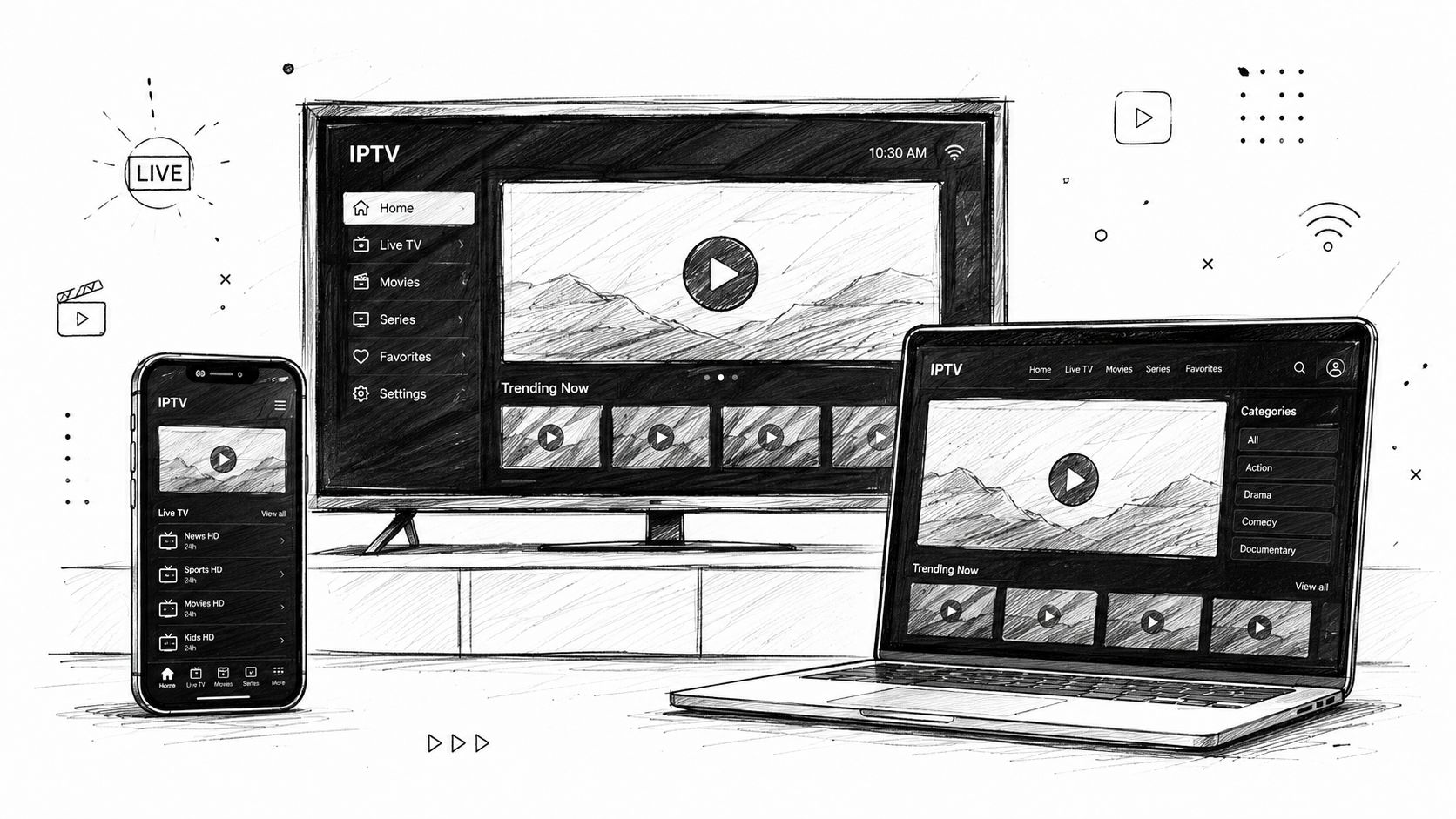
The setup mistake people make is overcomplicating it. Most IPTV installs boil down to getting the right app, entering credentials, and pointing the player at the provider's playlist or portal. The primary differences are device-specific quirks.
Firestick, Android TV and phones
Firestick and Android TV are usually the easiest route because they support a wide range of IPTV players. The first snag is permissions. You often have to allow installation from outside the default app store, then install a player that supports your provider's format.
On phones and tablets, the workflow is even simpler. Install the app, sign in, load the playlist, and check the EPG. If a service gives you credentials by WhatsApp or email, that's normal for this market, and it often happens quickly.
Smart TVs, Apple TV and MAG boxes
Smart TVs are where people get trapped by built-in app stores. Samsung, LG, and Sony stores don't always have the IPTV player you want, so many households end up using a streaming stick anyway. That's not a failure, it's just the practical route.
Apple TV and iOS usually want a clean, well-supported app and a tidy login flow. MAG boxes are different again. They usually need a portal URL rather than a simple playlist entry, so follow the provider's instructions exactly.
If the setup guide asks for a portal, don't paste a playlist into that field. Half the “it doesn't work” complaints start there.
What to expect after activation
The normal activation flow is boring, and that's good. You receive your login details, enter them on first launch, and the provider loads channels, VOD and the EPG. If a service claims to support an Electronic Programme Guide, look for it inside the player menu rather than expecting it to appear automatically.
For step-by-step walkthroughs by player and platform, the clearest place to start is the setup guides for supported devices. Use that before you start swapping apps at random, because most setup failures are format mismatches, not broken subscriptions.
Broadband, Wi-Fi and the 4K Headroom Rule
The headline speed on your contract is not the same thing as what IPTV gets at peak time. The number that matters is sustained throughput per stream, because live TV does not care what your line can do in a speed test at 10 a.m. It cares what arrives cleanly during the evening rush.
UK-oriented guidance puts HD at 5 to 10 Mbps per stream and 4K at about 25 Mbps per stream, with roughly 60 to 80 Mbps recommended for two 4K TVs plus normal household use (UK streaming equipment guidance). This is the key planning figure, not the marketing number.
The 4K headroom rule
Use this rule instead of guessing:
- One HD stream: fine on a modest line if the connection is stable.
- One 4K stream: leave comfortable headroom above 25 Mbps.
- Two 4K streams: plan for the 60 to 80 Mbps range once phones and laptops are counted in.
- Live sport at peak time: leave extra buffer, because adaptive bitrate drops are what you notice first.
Ofcom's Connected Nations 2025 reporting says the UK median fixed broadband download speed reached 223 Mbit/s in March 2025, but performance still varies sharply by access technology and location (Ofcom Connected Nations 2025). That's why one household can run multiple 4K streams with no complaint while another struggles on paper with a decent package.
What actually improves playback
Ethernet beats Wi‑Fi for the main TV whenever you can run it. It removes one of the biggest sources of jitter and random dropouts. If you can't cable the room, keep the router or access point away from physical obstructions and noisy electronics, then use the cleaner band on your network equipment.
For a practical walkthrough on cleaning up home coverage, expert advice on wifi is worth reading alongside this rule. It's the kind of advice people only seek after a match freezes at the worst possible moment.
VPNs, Throttling and Basic Privacy
A VPN helps in IPTV, but it is no magic fix. It can improve privacy and, in some cases, blunt ISP traffic shaping, yet it will not turn a weak line into a stable one. If the provider's servers are overloaded or your Wi‑Fi is poor, the VPN will not save the stream.
The split is simple. Throttling is about how traffic is treated on the network path. Privacy is about who can see your logins, payment details, and viewing habits. They call for different fixes.
When a built-in VPN is enough
Some IPTV apps bundle VPN protection into the service. That is useful if you want a basic layer of privacy on a home network, or if you are abroad and trying to reach UK content. It is enough for casual use if the app's setup is tidy and the exit point is fast.
A separate paid VPN makes more sense when you want coverage across the whole device, not just inside the IPTV player. It also gives you more control over which UK endpoint you use, which matters if you want to keep latency under control. If you are travelling and need a clear route back to UK services, follow this guide to watching UK TV abroad alongside your provider setup.
Privacy habits that matter
- Use unique passwords for IPTV logins, and do not recycle the one you use for email or shopping.
- Keep devices updated, especially Firesticks, Android boxes, and smart TVs.
- Be careful with payment details on reseller sites that look thin or improvised.
- Use a VPN when abroad if you need access to UK feeds and your provider supports it.
Basic online anonymity matters too. The guide to online anonymity for job seekers covers the general habit of reducing unnecessary exposure online, and the same thinking applies to IPTV logins and payments. Keep the setup simple, but do not get sloppy.
One more point for UK households. A provider that pushes a one-time payment and promises everything forever deserves extra suspicion. That model often hides weak support, poor list management, or a service that can vanish once too many people sign up. Pay attention to how the provider handles access controls, device limits, and account recovery, because that tells you more than any sales pitch.
Troubleshooting and FAQs for UK Viewers
Buffering on a live sports feed usually comes from one of four places. The first is line congestion at peak time. The second is Wi‑Fi instability. The third is the provider's own server load. The fourth is too little headroom for the stream you've chosen. Start by moving the device to Ethernet if you can, then test on another player or another room before blaming the subscription.
If channels disappear after a daily update, don't panic and don't start reinstalling everything. That usually points to a list refresh or a temporary server-side issue. Try refreshing the playlist, restarting the app, and checking whether the provider has changed channel ordering or EPG links.
Fast fixes for the problems people report most
- Audio out of sync: switch decoder settings in the player, then reboot the app.
- EPG not loading: check the EPG URL or refresh option before you reinstall the app.
- Sports feed buffering: reduce the stream quality for a test, then retest on Ethernet.
- Channels missing after an update: wait for the provider's list refresh to settle, then reload.
A provider that updates lists often can look messy for a few minutes. That's annoying, but it's not the same as a broken service. A dead provider looks dead all day.
Questions buyers always ask
Can UK expats keep watching home channels abroad? Sometimes, yes, if the provider supports access outside the UK and the app or VPN setup is suitable. The practical limit is usually access policy and latency, not the country name itself.
What if the provider disappears mid-subscription? Treat that as a genuine consumer risk, especially with prepayment models. Keep records, check the payment method you used, and don't assume the seller will be around tomorrow if the website vanishes tonight.
Should I expect a refund? Only if the provider's terms clearly say so. A real refund policy is written down and easy to find. If it isn't, assume the money is at risk.
Will IPTV work over 4G or 5G home broadband? Sometimes it will, but that depends on stability, not just headline speed. Live TV hates jitter and dropouts, so test it during the evening, not when the mast is empty.
The buying rule stays the same. Start with a trial, check peak-time performance on your own line, and only then move to a longer plan.
If you want a fixed-term IPTV service with UK-oriented channel access, rapid activation, and device support that fits Firestick, smart TVs and mobile setups, take a look at UK Best IPTV. It's a straightforward place to compare trial access, plan lengths and setup guidance against the criteria in this guide, without tying yourself to a long contract before you've tested it properly.
Enhanced by the Outrank app